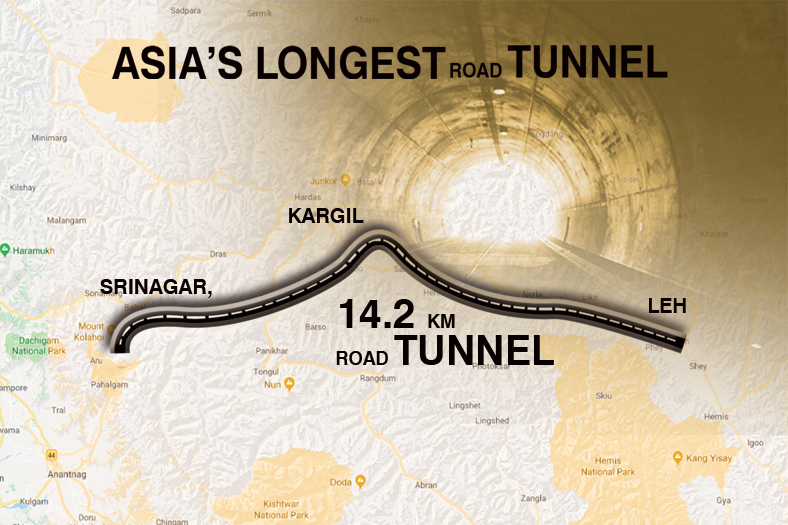
All-weather Zojila tunnel connects Srinagar and Leh: All you need to know


 Union minister Nitin Gadkari on Thursday launched the blasting of the Zojila tunnel, which will provide for all-year connectivity between Jammu and Kashmir’s Srinagar valley and Ladakh’s Leh on National Highway-1 that otherwise remains closed for six months due to snowfall.

Union minister for road transport, highways and MSMEs Gadkari said that the tunnel will improve socio-economic scenario in the region and during the ceremony informed that about Rs 4,000 crore was saved with the redesigning of this tunnel. “With honest efforts, we can take our country forward at lower costs,” he said.

Gadkari also hinted towards the completion of the project before the tenure of the incumbent NDA government ends, i.e. before the scheduled period of six years.

Here is everything you need to know about the Zojila tunnel:

1. The 14.15km long tunnel will be built at an altitude of about 3000 m under Zojila pass (presently motorable only for 6 months in a year) on NH-1 connecting Srinagar and Leh through Dras & Kargil. The stretch is one of the most dangerous in the world to drive and so the project is also geo-strategically sensitive.

2. While Zojila Tunnel will be 14.15m long, the approach road’s length will be 18.63km which means the entire project’s length is 32.78 km.

3. Gadkari said this will be the longest tunnel of Asia and added that it will improve the socio-economic scenario in the region.

4. The project will make the travel on the Srinagar-Kargil-Leh Section of NH-1 free from avalanches and enhance safety. It will also reduce the travel time from more than 3 hours to 15 minutes, the government said in a statement.

5. The Kargil administration has said that the tunnel will also benefit the Indian Army. The remarks come in the backdrop of India’s standoff with China People’s Liberation Army (PLA) along the Line of Actual Control (LAC) in Ladakh. Kargil district commissioner (DC) Baseer-ul-Haq Choudhary said the tunnel will add more teeth to the army’s defence operations in the strategic region. “It will be of great importance to the defence forces.

6. Choudhary also pointed to the importance of the tunnel from tourism point of view saying, “Ladakh being a tourist destination, the tunnel will give impetus to tourism, winter sports like ice hockey, skiing and other activities.”

7. “It was a long pending demand of the people of Ladakh. It will be a strategic tunnel that will keep the region connected with the rest of India all year, not just physically, but emotionally too,” he said.

8.Prime Minister Narendra Modi laid the foundation stone at Leh in May 2018 but work could not progress after July 2019 as IL&FS, the firm which was given the contract, ran into financial problems. The project was terminated on January 15, 2019. In February this year, Gadkari reviewed the project and approved it afresh in May and the contract was given to Megha Engineering & Infrastructure Ltd (MEIL).

Comments

Post a Comment

Use this website

Popular posts from this blog

DIGITAL INDIA ESSAY | DIGITAL INDIA ARTICLE | WHAT IS DIGITAL INDIA?

    INTRODUCTION ABOUT DIGITAL INDIA  Digital India is a campaign to ensure the government services are available to all the citizens of this country electronically through increasing internet connectivity and improved online infrastructure or by making the citizens of this country empowered (digitally) in the field of technology. This campaign was launched on 1 of July 2015 by the government of India under the  rule of Prime Minister- Narendra Modi with a motto of – “Power to Empower”. It holds/provides an important aspect to the other key schemes of India, such as Make in India, BharatNet, Standup India, Industrial corridors, Startup India, Sagarmala, UDAN-RCS, Bharatmala and Dedicated Freight Corridors. The main aim of this initiative is to connect rural areas with high-speed internet connectivity and increase digital literacy. This campaign comes under the Ministry of Electronics and Information Technology and is led by Ravi Shankar Prasad and P.P....

Developing countries have fewer fiscal tools and policy options to combat COVID-19 damage to their economies, according to research by Info Tech

The fiscal and monetary response to the coronavirus pandemic has been emergent, global, and deep. Some countries have more sophisticated fiscal and monetary tools—and the ability to use them swiftly—than others. The ability to compare policy actions fairly may be key to learning how officials around the world could improve responses to the next global financial catastrophe. Work done recently by dozens of Harvard Business School students under Alberto Cavallo, the Edgerley Family Associate Professor of Business Administration at Harvard Business School, may provide the most detailed guide yet. “SEEING THE BREADTH OF DIFFERENT POLICIES AND THE DIFFERENT STAKEHOLDERS THAT THEY TOUCH WAS SURPRISING." Cavallo, in searching for a way to explore a once-in-a-lifetime global event like the worldwide economic response to COVID-19, decided to enlist a sophisticated workforce already at his fingertips: Harvard MBA students. Over the course of three months, they created the Global Policy T...

Technology has transformed every aspect of life in UAE

  When   The National  launched in April 2008, it came into being first and foremost as a physical newspaper, with our website following rather than leading our coverage. Ten years later, it’s more likely that you’re reading this article on an iPhone, another product celebrating its tenth anniversary. Today,  The National  is a digital-first platform, with online content updated constantly throughout the day, catering to an audience in the UAE and beyond that is increasingly choosing to experience the world first and foremost via digital channels. The explosion of smartphone ownership in the UAE in the past 10 years, coupled with the country’s high internet penetration and government bodies’ readiness to embrace technology, has transformed nearly every aspect of life in the country, from how we communicate, to how we work, shop, get around, and pay our electricity bills. The UAE’s rulers have been quick to embrace the potential of technology to improve the lives...